Sub-pixel camera calibration accuracy depends as much on target flatness, contrast, and substrate stability as it does on the calibration algorithm. This guide helps machine vision engineers and metrology labs select the optimal combination of pattern geometry, substrate material, and illumination mode from the Cots Optics calibration catalogue.
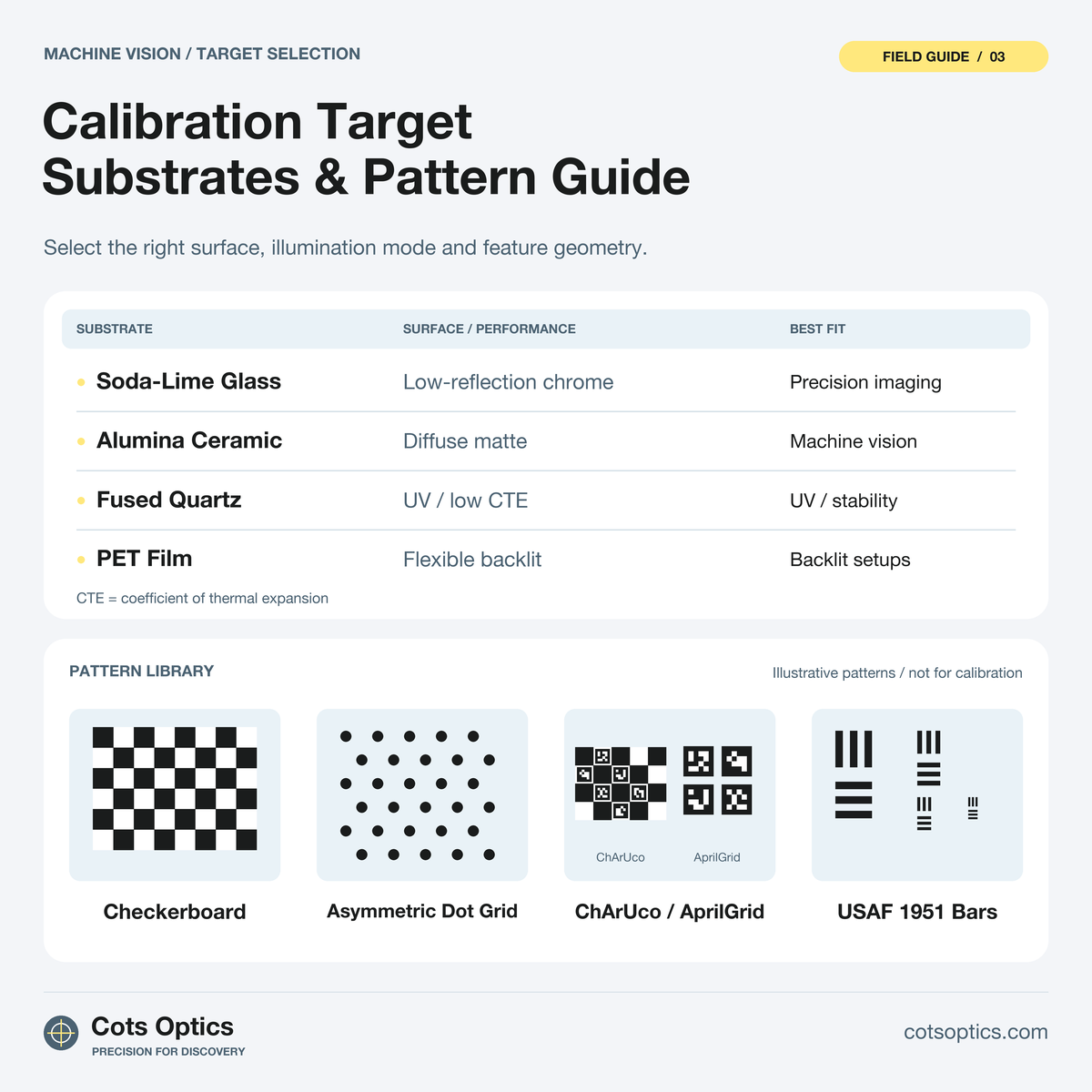
1. Comparing Calibration Target Substrates
| Substrate | Surface & Contrast | Key Strengths | Recommended Use |
|---|---|---|---|
| Soda-Lime Optical Glass (Chrome) | Low-reflection vacuum-deposited chrome | ±0.5 µm–±1 µm lithography precision, flat & transmissive | Telecentric lenses, backlit metrology, stereo vision calibration |
| Alumina Ceramic | Matte white diffuse reflective | Zero specular glare under bright coaxial or ring light | Industrial front-lit 2D/3D machine vision & robot hand-eye calibration |
| Fused Quartz (UV Grade) | Chrome on low-CTE quartz | Ultra-low thermal expansion, UV transmission | Precision microscopy, UV imaging, temperature-sensitive labs |
| Optical PET Film | Flexible transparent or matte white film | Lightweight, economical, shatter-proof, large formats | Backlit lightboxes, handheld inspection, defect comparison gauges |
2. Selecting the Right Calibration Pattern
- Checkerboard Targets: The universal OpenCV and MATLAB standard. Saddle-point corner detection is insensitive to moderate radial distortion and lighting gradients. Aim for the target to span 50–80% of your field of view across multiple tilted poses.
- Dot Grid & Halcon Targets: Circle centroids offer exceptional noise immunity under slight defocus. Symmetric or asymmetric dot arrays (such as standard Halcon 7×7 and 9×9 matrices) excel in industrial multi-camera systems.
- ChArUco, AprilGrid & Type II Coded Targets: Embedded fiducial markers allow calibration even when the target is partially occluded or clipped at image edges—ideal for wide-angle lenses, close-range stereo rigs, and automated robot cells.
- USAF 1951 & Siemens Star Resolution Targets: Quantify limiting spatial frequency (lp/mm), astigmatism, and optical focus across the field of view. Pair with ISO 12233 eSFR, Grayscale & Color Checker Charts for complete camera image-quality qualification.
- Glass Scales & Round Reticles: Verify absolute magnification, depth of field, and reticle alignment in microscopes and vision measuring machines.
3. Sizing Your Pattern Pitch to Field of View (FOV)
As a practical rule of thumb, choose a checkerboard square size or dot spacing that spans 15–40 pixels on your camera sensor, with total pattern dimensions covering roughly 60–75% of the active FOV. Avoid overly dense grids where squares drop below 8 pixels (causing aliasing) or overly coarse targets that leave lens corners under-sampled.

Custom Lithography & Bulk Vision Kits
Standard targets ship directly online via Stripe checkout (free FedEx shipping over $1,800). If you require a custom array count, non-standard dot diameter, special ChArUco dictionary, or custom glass/ceramic outline, send your drawing via Request a Quote or email [email protected].